
Light Novels to Read
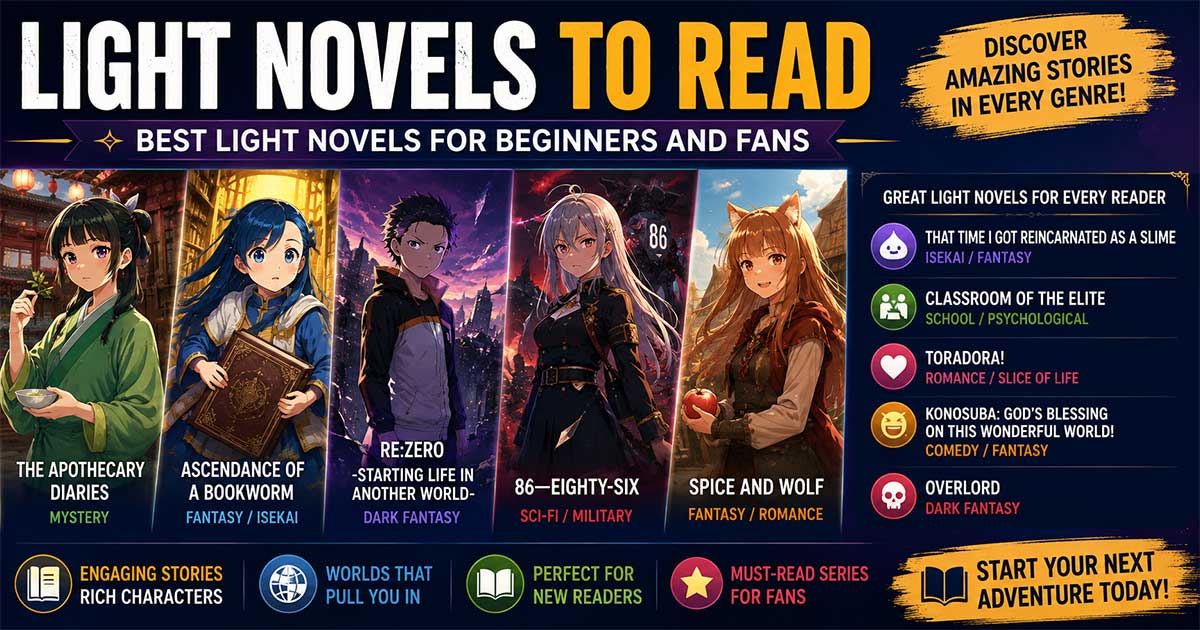
Light Novels to Read: Best Light Novels for Beginners and Fans
Finding the best Light Novels to read can be surprisingly difficult. The English-language market now includes everything from enormous isekai adventures and psychological thrillers to historical mysteries, romantic dramas, science fiction, and comedy.
For someone discovering the format through anime—or still learning what exactly a Light Novel is—the sheer number of series can make choosing a first Light Novel intimidating. Experienced readers face a different problem: finding books that offer something beyond familiar formulas.
The best starting point is therefore not a single universal ranking. It is understanding what different Light Novels do particularly well and matching those strengths to the type of story you enjoy.
This guide highlights established series that represent different sides of the medium, from accessible entry points to ambitious long-form stories.
Best Light Novels to Read at a Glance
| Light Novel | Best For | Main Genre |
|---|---|---|
| The Apothecary Diaries | Mystery and clever protagonists | Historical mystery |
| Ascendance of a Bookworm | Deep worldbuilding | Fantasy / Isekai |
| Re:ZERO | Dark, psychological fantasy | Isekai / Fantasy |
| 86—Eighty-Six | Serious dramatic storytelling | Science fiction / Military |
| Spice and Wolf | Character chemistry and economics | Fantasy / Romance |
| That Time I Got Reincarnated as a Slime | Accessible fantasy adventure | Isekai / Fantasy |
| Classroom of the Elite | Psychological competition | School / Drama |
| Toradora! | Character-driven romance | Romantic comedy |
| KonoSuba | Comedy and fantasy parody | Isekai / Comedy |
| Overlord | Dark fantasy and worldbuilding | Isekai / Dark fantasy |
These books are not ranked strictly from best to worst. They represent different strengths of the Light Novel format and give new readers several useful entry points.
Readers looking for a more selective ranking can also explore our top Light Novels, based on storytelling, influence, worldbuilding, reader recognition, and impact on the medium.
1. The Apothecary Diaries — Best for Mystery Fans
The Apothecary Diaries is an excellent example of how diverse Light Novels can be.
Rather than relying on a conventional fantasy adventure, the story follows Maomao, a highly intelligent young woman with extensive knowledge of medicine, herbs, and poisons. After finding herself inside an imperial court, she becomes involved in a succession of medical mysteries and political intrigues.
Its greatest strength is its protagonist.
Maomao solves problems through observation and knowledge rather than overwhelming supernatural abilities. Court politics, medicine, social hierarchy, and mystery gradually intersect as apparently isolated incidents reveal larger consequences.
For readers who associate Light Novels exclusively with isekai fantasy, The Apothecary Diaries is an excellent demonstration of the medium's broader possibilities.
Best for: mystery, historical settings, intelligent protagonists, court intrigue.
2. Ascendance of a Bookworm — Best for Worldbuilding
The premise of Ascendance of a Bookworm sounds simple: a book-loving woman dies and is reincarnated as Myne, a physically fragile young girl living in a world where books are prohibitively expensive.
Her solution is equally straightforward:
If she cannot buy books, she will make them herself.
What begins as a personal obsession gradually becomes an unusually detailed exploration of technology, commerce, religion, class, family, politics, and social change.
This makes the series particularly interesting for readers who enjoy watching a fictional world develop logically.
Myne cannot simply reproduce modern technology overnight. Materials cost money. Knowledge must be adapted to local conditions. Social classes restrict what she can do. Even seemingly simple inventions can produce economic and political consequences.
The result is one of the strongest choices for readers looking for a Light Novel with extensive worldbuilding rather than constant combat.
Best for: worldbuilding, economics, invention, social systems, long-form fantasy.
3. Re:ZERO −Starting Life in Another World− — Best for Dark Isekai
Re:ZERO begins with a familiar premise: Subaru Natsuki suddenly finds himself transported to another world.
His unusual ability changes everything.
When Subaru dies, he returns to an earlier point in time.
That concept transforms what could have been a straightforward fantasy adventure into a psychological struggle. Subaru can use information gained during previous attempts, but doing so often requires experiencing failure, fear, loss, and death repeatedly.
The series explores the emotional cost of a power that initially sounds enormously advantageous.
For readers coming from the anime, the Light Novel also provides the benefit inherent to prose: greater access to thoughts, motivations, explanations, and details that visual adaptations may condense.
Best for: dark fantasy, psychological drama, time loops, character development.
4. 86—Eighty-Six — Best for Science Fiction and Military Drama
Readers who want proof that Light Novels can tackle serious political and social themes should consider 86—Eighty-Six.
The story takes place amid a supposedly automated war. Behind that convenient official narrative lies a disturbing reality involving marginalized soldiers forced to fight while the privileged population remains protected from the consequences.
The series combines military science fiction with questions about discrimination, propaganda, dehumanization, responsibility, and survival.
Its appeal comes not simply from battles but from the human relationships behind them.
That makes 86—Eighty-Six a particularly strong recommendation for readers accustomed to conventional science-fiction or war novels who want an entry point into Light Novels.
Best for: military science fiction, political themes, drama, serious character arcs.
5. Spice and Wolf — Best for Fantasy Romance
Spice and Wolf demonstrates that a fantasy story does not require endless monster battles or magical wars.
The series follows traveling merchant Kraft Lawrence and Holo, a wolf deity associated with harvests.
Their journey combines romance, economics, trade, negotiation, religion, and medieval-inspired society.
The central attraction is the relationship between Lawrence and Holo. Their conversations, arguments, teasing, and gradual emotional development give the series its distinctive personality.
At the same time, commercial problems often function as genuine plot mechanisms. Prices, currencies, speculation, negotiations, and market conditions can matter as much as swords or magic would in another fantasy series.
Best for: romance, character chemistry, economics, medieval fantasy.
6. That Time I Got Reincarnated as a Slime — Best Accessible Isekai
For readers looking specifically for a welcoming introduction to isekai Light Novels, That Time I Got Reincarnated as a Slime is an obvious candidate.
After dying in modern Japan, the protagonist is reincarnated in another world as a slime and eventually takes the name Rimuru Tempest.
The unusual protagonist is only the beginning.
As the story expands, Rimuru forms alliances, gathers different species, develops a community, and becomes increasingly involved in diplomacy, economics, warfare, and nation-building.
The combination of humor, progression, fantasy adventure, and an expanding world makes the series accessible to newcomers while giving long-term readers plenty to explore.
Best for: beginners, isekai, progression, nation-building, fantasy adventure.
7. Classroom of the Elite — Best for Psychological Competition
Not every popular Light Novel takes place in a fantasy world.
Classroom of the Elite is set in a prestigious school built around an elaborate competitive system. Students receive unusual freedom, but their privileges are tied to performance and a hierarchy between classes.
Behind that structure lies constant strategic conflict.
The series focuses heavily on manipulation, alliances, deception, social pressure, and psychological competition. Its protagonist, Kiyotaka Ayanokōji, is deliberately difficult to read, which makes uncovering his abilities and motivations part of the appeal.
Readers interested in strategy rather than fantasy combat may find this a much stronger introduction to Light Novels than a conventional isekai.
Best for: psychological drama, strategy, school settings, social competition.
8. Toradora! — Best for Romantic Comedy
Toradora! remains a useful recommendation for readers interested in the romance side of Light Novels.
Ryuuji Takasu and Taiga Aisaka initially cooperate because each is interested in the other's friend. Predictably, their arrangement becomes considerably more complicated.
What gives the series longevity is its emphasis on personality and emotional development rather than simply its romantic premise.
Comedy creates the initial energy, but relationships become more complicated as characters confront insecurity, family problems, friendship, jealousy, and changing feelings.
For readers who primarily associate Light Novels with fantasy, Toradora! provides an accessible route into character-driven contemporary stories.
Best for: romance, comedy, school life, character development.
9. KonoSuba: God’s Blessing on This Wonderful World! — Best for Comedy
Many isekai stories present another world as an opportunity for adventure and greatness.
KonoSuba prefers to make the entire situation go spectacularly wrong.
Kazuma Satou finds himself in a fantasy world accompanied by Aqua, a goddess whose usefulness does not always match her confidence. Their eventual adventuring party is filled with characters possessing powerful abilities combined with equally powerful personality problems.
The humor frequently comes from undermining fantasy and role-playing-game expectations.
Instead of an ideal team efficiently defeating every obstacle, the characters create many of their own problems.
For readers who enjoy anime comedy and want something lighter than the psychological intensity of Re:ZERO or the military drama of 86, KonoSuba offers a very different experience.
Best for: comedy, fantasy parody, eccentric characters, isekai.
10. Overlord — Best for Dark Fantasy
Overlord begins with a player remaining inside a virtual-reality game as its servers are about to shut down—only to discover that the world has apparently become real.
More importantly, he inhabits the body of Momonga, an enormously powerful undead character surrounded by loyal non-player characters who now appear to possess genuine personalities.
The resulting story approaches isekai from an unusual perspective.
Instead of following a weak hero slowly becoming powerful, Overlord begins with overwhelming power and explores how that power affects the surrounding world.
Politics, military strategy, competing nations, morality, and the perspectives of comparatively ordinary inhabitants all contribute to its larger narrative.
Best for: dark fantasy, powerful protagonists, politics, extensive worldbuilding.
How to Choose Your First Light Novel
The best first Light Novel depends less on rankings than on your existing interests.
If you enjoy mystery novels, start with The Apothecary Diaries. For detailed fantasy societies and long-term worldbuilding, Ascendance of a Bookworm is particularly strong. Readers seeking intense psychological fantasy can try Re:ZERO, while science-fiction fans may prefer 86—Eighty-Six.
For romance, Spice and Wolf and Toradora! offer very different approaches. Comedy fans have KonoSuba, while readers looking for large-scale dark fantasy can explore Overlord.
There is also another effective strategy: start with the source material of an anime you already love.
Familiar characters and settings reduce the barrier to entering a new reading format. The Light Novel may then provide additional scenes, internal thoughts, worldbuilding, and explanations that were shortened or omitted during adaptation.
Should You Read the Light Novel If You Watched the Anime?
Often, yes—particularly if you want the fullest version of the story.
Anime adaptations operate under different constraints from books. Episodes have limited running times, seasons have limited episode counts, and prose cannot always be translated directly into visual storytelling.
As a result, adaptations may compress dialogue, remove internal monologues, shorten explanations, combine scenes, or stop long before the source series ends.
That does not automatically make the anime inferior.
It simply means the Light Novel and anime provide different experiences.
For many fans, watching an adaptation becomes the beginning rather than the end of their relationship with a series.
Where Should Beginners Start?
New readers do not need to begin with the most famous or longest Light Novel series.
A better approach is to choose one whose genre already appeals to you and read the first volume.
Light Novels are frequently structured so that individual volumes provide meaningful narrative progress. That makes experimenting relatively easy: you can determine whether you enjoy the characters, prose, translation, and world before committing to a long series.
Digital editions can also make exploring multiple series easier, while physical editions appeal to readers who value cover artwork and interior illustrations.
Readers looking for legal digital and print options can compare established Light Novel websites to find publishers, stores, and reading platforms.
Frequently Asked Questions
What are the best Light Novels for beginners?
The Apothecary Diaries, That Time I Got Reincarnated as a Slime, Spice and Wolf, and KonoSuba are accessible starting points representing several different genres.
What Light Novel should I read after watching anime?
Starting with the original Light Novel of an anime you already enjoyed is often an excellent choice. It provides familiar characters while potentially adding scenes, thoughts, and details absent from the adaptation.
Are Light Novels only fantasy or isekai?
No. Light Novels include romance, mystery, science fiction, comedy, school drama, supernatural fiction, historical-inspired stories, and many other genres.
Are Light Novels good for adults?
Yes. Although the category is historically associated with younger audiences, many series attract substantial adult readership and explore complex political, psychological, social, or philosophical themes.
Are Light Novels easy to read?
Many emphasize accessible prose, dialogue, and relatively compact volumes, making them approachable. Difficulty still varies considerably depending on the author, translation, genre, and complexity of the story.
Do I need to read a manga before the Light Novel?
No. When a Light Novel is the original source, it can normally be read independently. A manga adaptation is a separate interpretation of the same story.
Conclusion
There is no single definitive list of Light Novels to read, because one of the format's greatest strengths is its variety.
The Apothecary Diaries offers intelligent mystery. Ascendance of a Bookworm provides extraordinarily detailed worldbuilding. Re:ZERO transforms isekai into psychological drama. 86—Eighty-Six explores war and discrimination. Spice and Wolf combines romance with economics, while KonoSuba turns fantasy conventions into comedy.
For beginners, the best Light Novel is therefore not necessarily the one at the top of somebody else's ranking. It is the series that connects the format with something you already enjoy.
And once that first book works, an enormous world opens up: fantasy kingdoms, imperial courts, futuristic battlefields, school competitions, romantic journeys, supernatural mysteries, and countless other stories—all demonstrating just how broad the modern Light Novel has become.
You should also read:
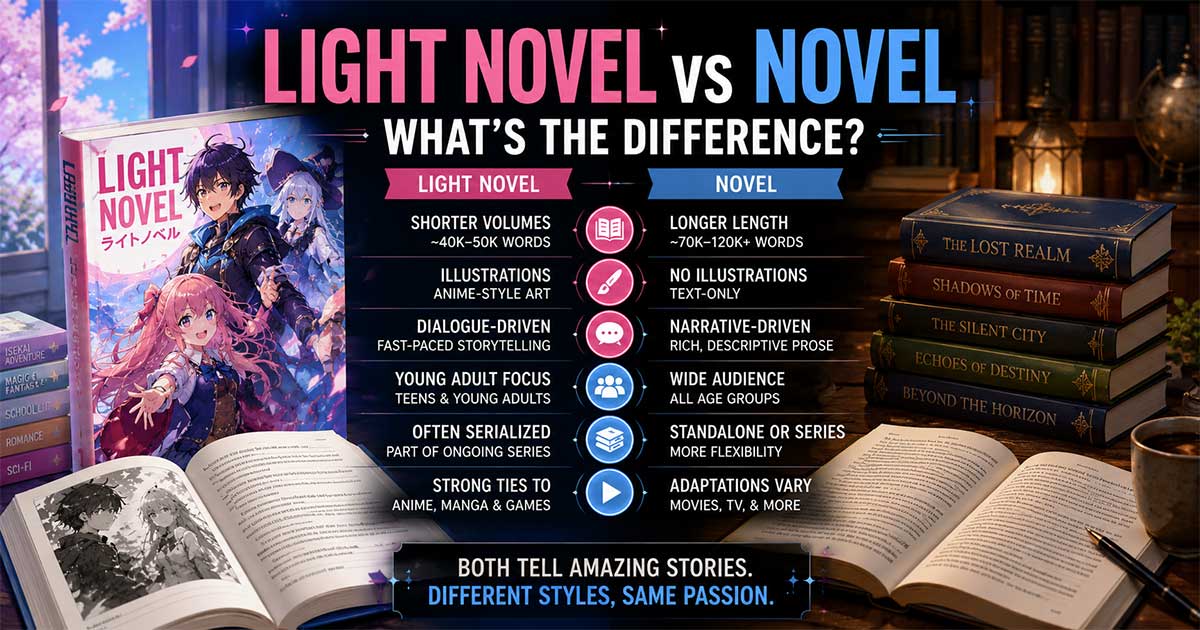
Light Novel vs Novel
Light Novel vs Novel: What’s the Difference? The distinction between a Light Novel and a traditional novel can seem confusing at first. Both are books. Both rely primarily on prose. Both can tell complex stories, develop memorable characters, span multiple volumes, and explore genres ranging…
Continue reading...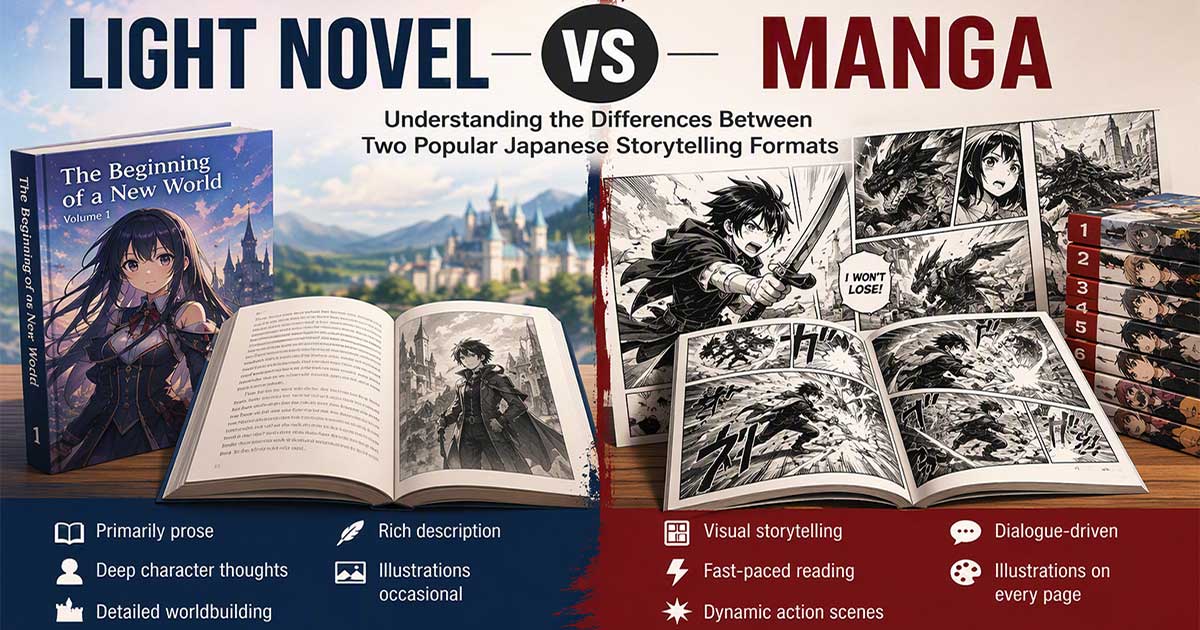
Light Novel vs Manga
Light Novel vs Manga: Understanding the Differences Between Two Popular Japanese Storytelling Formats Japanese storytelling has become a global phenomenon. From bestselling manga to blockbuster anime adaptations, millions of readers discover new stories every year. Yet one format often remains misunderstood outside Japan: the Light…
Continue reading...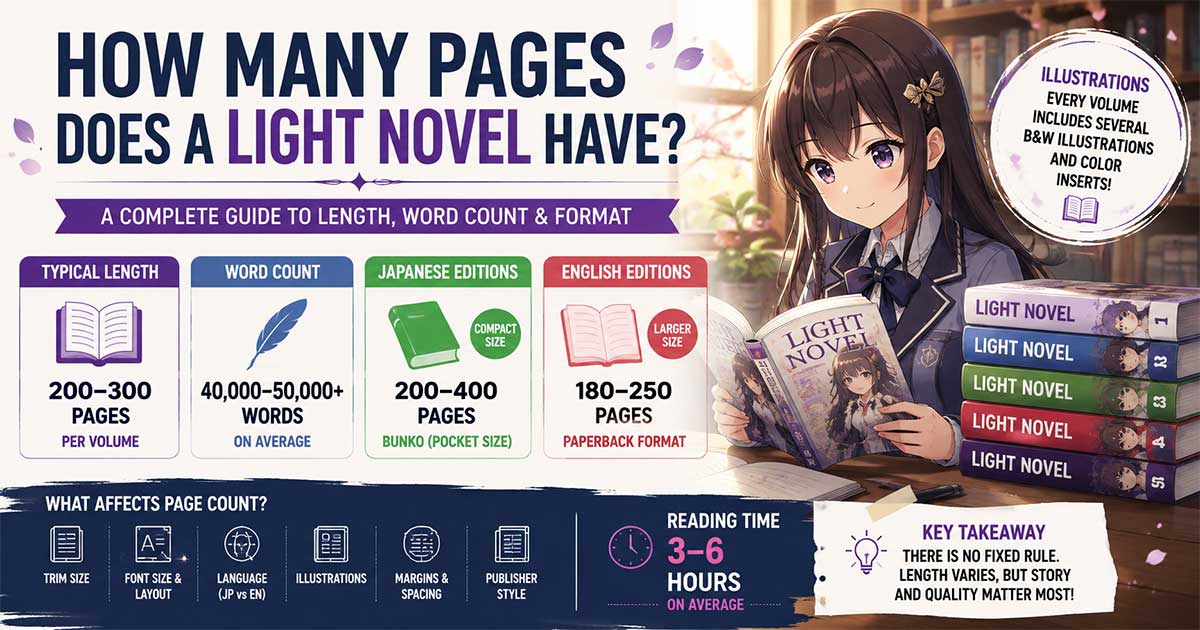
How Many Pages Does a Light Novel Have?
How Many Pages Does a Light Novel Have? Length, Word Count and Format Explained A typical Light Novel contains roughly 200 to 300 pages per volume, but that number is only a useful reference point—not a publishing rule. Some volumes are considerably shorter, while others…
Continue reading...