
Light Novel vs Novel
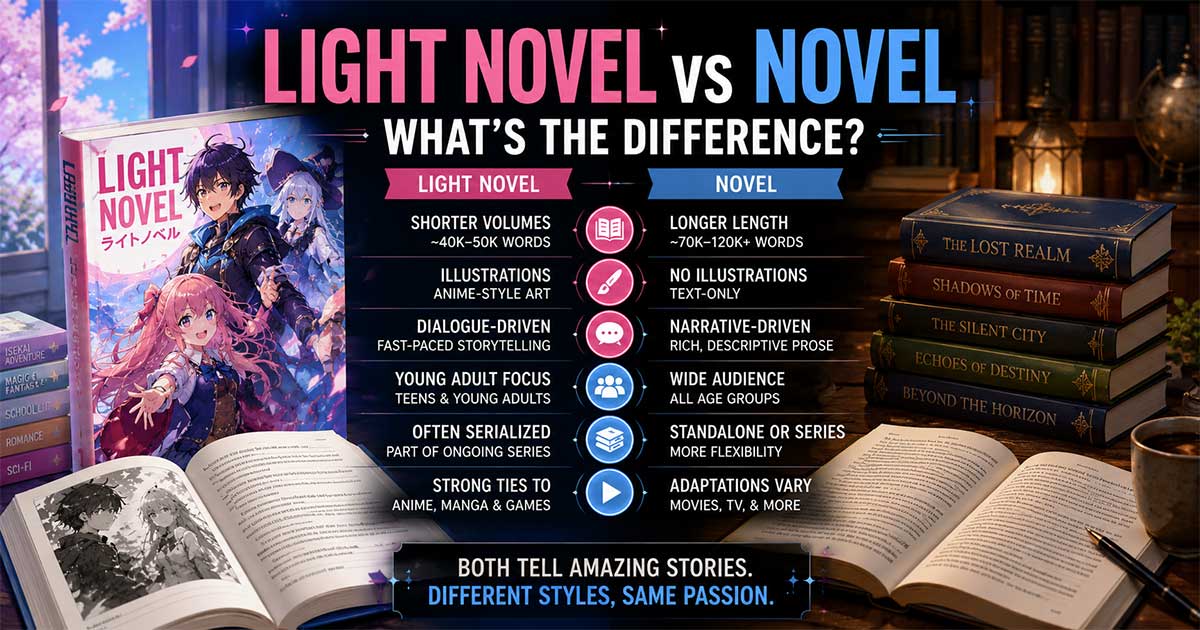
Light Novel vs Novel: What’s the Difference?
The distinction between a Light Novel and a traditional novel can seem confusing at first. Both are books. Both rely primarily on prose. Both can tell complex stories, develop memorable characters, span multiple volumes, and explore genres ranging from romance and fantasy to science fiction and mystery.
Yet a Light Novel is not simply a shorter version of a regular novel.
The term refers to a publishing tradition that developed in Japan and became closely connected with manga, anime, illustrated character design, and serialized storytelling. Traditional novels, meanwhile, encompass an enormous range of literary and commercial fiction produced for virtually every audience.
Understanding Light Novel vs Novel therefore requires looking beyond page counts. The real differences involve publishing culture, presentation, target readership, storytelling conventions, illustrations, series structure, and the relationship between books and other entertainment media.
Light Novel vs Novel: The Basic Difference
The most important point is also the easiest to overlook:
A Light Novel is a novel.
It is not a separate medium in the way manga or anime is. Light Novels tell stories primarily through written prose, just as traditional novels do.
The distinction comes from the publishing category.
A Light Novel (raito noberu, ライトノベル) is traditionally associated with Japanese popular fiction, often marketed toward teenagers and young adults. Light Novels frequently use anime- or manga-style illustrations and are commonly released as continuing series of relatively compact volumes.
To understand what defines a Light Novel, it is important to recognize its roots in Japanese popular fiction, where the format has traditionally been marketed toward teenagers and young adults.
A traditional novel, by comparison, is a much broader category. It can be literary or commercial, short or extremely long, illustrated or unillustrated, standalone or serialized, and intended for children, teenagers, adults, or a general readership.
This makes the comparison somewhat asymmetrical. “Novel” describes the larger literary form; “Light Novel” identifies a particular publishing tradition within prose fiction.
Light Novel vs Traditional Novel at a Glance
| Feature | Light Novel | Traditional Novel |
|---|---|---|
| Primary medium | Prose | Prose |
| Origins | Strongly associated with Japan | Worldwide |
| Typical audience | Often teens and young adults | All age groups |
| Illustrations | Common | Usually uncommon in adult fiction |
| Visual style | Often anime/manga-inspired | Varies widely |
| Length | Often relatively compact per volume | Highly variable |
| Dialogue | Frequently prominent | Depends on author and genre |
| Series format | Very common | Common, but not required |
| Anime/manga connection | Frequently strong | Usually incidental |
| Genres | Fantasy, isekai, romance, sci-fi, school life, etc. | Every literary genre |
These are tendencies, not rigid rules. A book does not cease to be a Light Novel because it is unusually long or contains fewer illustrations.
Are Light Novels Shorter Than Regular Novels?
Usually, but not always.
Many Light Novel volumes are designed to provide a relatively compact reading experience. Figures around 40,000 to 50,000 words are frequently cited as representative of the format, although actual lengths vary considerably between publishers, series, authors, and individual volumes.
Traditional novels have an even wider range.
A commercial novel might contain 70,000 to 100,000 words, while epic fantasy books can exceed 150,000 words. At the other extreme, short novels and novellas may be comparable in length to—or shorter than—many Light Novels.
This is why word count alone cannot define the difference.
A 45,000-word American fantasy novel does not automatically become a Light Novel, just as an unusually long Japanese Light Novel does not automatically become a traditional novel.
What About Page Count?
Page count is an equally unreliable definition.
Many Light Novel editions fall roughly within the 200-to-300-page range, but some are shorter and others considerably longer.
A closer look at how many pages a Light Novel has also shows why trim size, translation, typography, and illustrations can make page counts vary significantly between editions.
Page counts also change between editions.
Japanese and English books can use different page dimensions, fonts, margins, spacing, illustrations, and typesetting. The same story can therefore have significantly different page counts after translation.
Length is a characteristic worth considering, but publishing context is more important than a numerical threshold.
Do Light Novels Have More Illustrations?
This is one of their most recognizable characteristics.
A typical Light Novel often has an illustrated cover featuring its main characters and several interior illustrations. Some volumes include color pages near the beginning and black-and-white artwork throughout the book.
Traditional adult novels, by contrast, usually contain little or no interior artwork.
But calling a Light Novel an “illustrated novel” can create the wrong impression.
The illustrations are supplementary.
Readers may encounter many consecutive pages containing nothing but text. Battles, conversations, descriptions, character thoughts, and worldbuilding still depend primarily on the author's prose.
This creates the fundamental difference between a Light Novel and manga.
In a manga, removing the artwork would make the story largely impossible to follow because the images are the principal narrative medium. In a Light Novel, the prose remains the foundation of the story.
Is the Writing Style Different?
Light Novels are frequently associated with accessible, fast-moving prose, substantial dialogue, character interaction, and relatively direct storytelling.
That description is useful, but it should not become a stereotype.
There is no rule requiring Light Novel authors to use simplistic vocabulary or avoid detailed descriptions. Individual series vary enormously.
A romantic comedy might rely heavily on rapid dialogue and humorous character reactions. An isekai adventure may devote considerable attention to magic systems, economics, geography, or politics. A psychological or mystery series can require intricate plotting and extensive internal narration.
Traditional novels are just as diverse.
Literary fiction may emphasize language, symbolism, and interiority, while a commercial thriller might employ short chapters, direct prose, and rapid dialogue that feel every bit as fast-paced as a Light Novel.
The better distinction is therefore one of common conventions rather than mandatory writing rules.
Does “Light” Mean Simple or Easy?
No.
This is one of the most persistent misunderstandings surrounding the term Light Novel.
“Light” should not be interpreted as meaning intellectually shallow, childish, cheerful, or devoid of serious themes.
Light Novels can address death, war, discrimination, political conflict, trauma, morality, sexuality, social hierarchy, and other mature subjects.
The Japanese expression raito noberu developed as a publishing term. In practice, “light” is better associated with the format's approachable presentation and popular-fiction tradition than with a measurement of literary complexity.
A Light Novel can be easy to read while exploring difficult ideas.
Those two qualities are not contradictory.
Light Novels Are Often Built Around Series
Another noticeable difference is the importance of serialized volumes.
Many Light Novels are conceived as continuing series. Instead of publishing one enormous book containing an entire adventure, the story may unfold across numerous compact volumes.
Each volume can contain its own narrative arc while advancing a larger story.
Traditional fiction also has series, of course. Fantasy, mystery, romance, and science fiction have produced countless multi-book sagas.
The difference is one of emphasis.
Regular releases and continuing character arcs are deeply embedded in modern Light Novel publishing. This structure also works particularly well when a property expands into manga, anime, games, merchandise, and other formats.
Light Novels Have a Stronger Connection to Anime and Manga
Perhaps the greatest cultural distinction in Light Novel vs Novel is the Light Novel's relationship with Japan's wider entertainment industry.
A successful Light Novel can become the foundation of a multimedia franchise.
Well-known examples include Sword Art Online, Re:Zero − Starting Life in Another World, That Time I Got Reincarnated as a Slime, and The Rising of the Shield Hero. These properties became familiar to enormous international audiences through anime and manga adaptations.
The relationship can take several forms. A story may originate online as a web novel before being professionally edited and published as a Light Novel. The Light Novel may then receive a manga adaptation, followed by anime, games, or other products.
A simplified progression might look like:
Web Novel → Light Novel → Manga → Anime
However, this is not a mandatory sequence. Some Light Novels are original commercial works rather than web novel adaptations, and adaptation paths vary considerably.
Traditional novels can certainly become movies, television series, comics, or games. What distinguishes the Light Novel ecosystem is how closely this cross-media development has become associated with the category itself.
Light Novel vs Novel: Target Audience
Light Novels have historically been strongly associated with teenage and young adult readers, although their actual readership extends well into adulthood.
Their covers, illustrations, character archetypes, genres, and marketing frequently overlap with audiences interested in manga and anime.
Traditional novels have no comparable unified demographic.
A novel might target children, young adults, romance readers, fantasy enthusiasts, literary audiences, crime readers, academics, or virtually any other group.
This difference also influences presentation.
Light Novel covers often foreground illustrated characters because those characters form an important part of the product's identity. Traditional novel covers may instead emphasize typography, objects, landscapes, symbols, photography, or abstract graphic design.
Neither approach is inherently superior. They reflect different publishing traditions and audiences.
Are Light Novels Only Japanese?
Historically and culturally, Light Novel is a Japanese publishing term.
That origin matters.
However, international publishing has complicated the definition.
Japanese Light Novels are now widely translated into English and other languages. At the same time, writers outside Japan increasingly create original prose fiction deliberately influenced by Light Novel conventions.
These books may use anime-style illustrations, serialized volumes, dialogue-driven narratives, fantasy or isekai settings, and other characteristics associated with Japanese Light Novels.
The term Original English Light Novel, sometimes abbreviated OELN, is consequently used for some English-language works created within this tradition.
There remains debate over terminology. A strict definition reserves “Light Novel” for works originating within the Japanese publishing market. A broader modern definition recognizes an emerging international Light Novel format influenced by Japan.
For readers, the most useful approach is to recognize both meanings and identify the publishing context of a particular work.
Is a Light Novel the Same as a Novella?
No.
The terms describe different things.
A novella is primarily a classification based on literary length. Definitions vary, but it generally occupies the territory between a short story and a full-length novel.
A Light Novel is a publishing category and cultural format.
The two can overlap in length, which creates confusion. A Light Novel volume might contain approximately as many words as a Western novella, but that does not make the terms interchangeable.
A novella does not need manga-style artwork, Japanese publishing connections, a young-adult audience, or serialized volumes.
Similarly, a Light Novel does not stop being one because its word count exceeds a particular novella threshold.
Which Is Better: Light Novel or Novel?
Neither format is inherently better.
The choice depends on what a reader wants.
Readers who enjoy anime, manga, character-focused fantasy, isekai, romantic comedy, serialized adventures, or illustrated character designs may find Light Novels particularly appealing.
Readers looking for literary experimentation, massive standalone narratives, historical fiction, adult crime, hard science fiction, or other traditions may find more options in the broader novel market.
But the categories overlap far more than they conflict.
Someone who enjoys fantasy novels can enjoy Light Novels. Someone who begins reading prose through anime adaptations can eventually explore traditional novels. Readers do not have to choose one format over the other.
Frequently Asked Questions
What makes a novel a Light Novel?
A Light Novel is traditionally a Japanese publishing category associated with popular prose fiction, often aimed at teens and young adults and frequently featuring anime- or manga-style illustrations. There is no single word-count or page-count requirement.
Is a Light Novel a real novel?
Yes. A Light Novel tells its story primarily through prose and is fundamentally a type of novel. The term identifies a particular publishing tradition rather than an entirely different storytelling medium.
Are Light Novels easier to read than novels?
Many use accessible prose and dialogue-driven storytelling, but difficulty varies by series, author, genre, and translation. Some Light Novels contain extensive worldbuilding and complex themes.
How many pages does a Light Novel have?
Many individual volumes are around 200 to 300 pages, but there is no fixed requirement. Page count can also change substantially between Japanese editions and translations.
What is the difference between a Light Novel and a novella?
A novella is primarily categorized by length. A Light Novel is identified by publishing tradition, market positioning, presentation, and other conventions. Their word counts can overlap.
Do all Light Novels have illustrations?
Illustrations are extremely common and strongly associated with the format, but they do not replace the prose. The story remains primarily textual.
Conclusion
The difference between a Light Novel and a novel cannot be reduced to “short book versus long book” or “illustrated book versus book without pictures.”
A Light Novel is a novel, but one associated with a distinctive Japanese publishing tradition.
Light Novels commonly feature relatively compact volumes, anime- or manga-style illustrations, accessible prose, strong character interaction, younger target demographics, continuing series, and close relationships with manga and anime adaptations. Traditional novels encompass a much broader global publishing landscape and have no single visual style, audience, length, or storytelling convention.
Most importantly, none of these characteristics creates an absolute boundary.
A long Light Novel remains a Light Novel. A short traditional novel does not automatically become one. A dialogue-heavy Western fantasy book is still not necessarily a Light Novel, and illustrations alone do not determine the category.
For readers, the most useful way to understand Light Novel vs Novel is therefore not as two competing forms of storytelling, but as a relationship between a specialized publishing tradition and the much larger world of prose fiction.
You should also read:

Light Novel Websites
Light Novel Websites: Where to Read, Learn, and Explore the World of Light Novels The popularity of the light novel has expanded far beyond Japan. As more readers discover this unique style of storytelling, the number of light novel websites has grown significantly. Today, some…
Continue reading...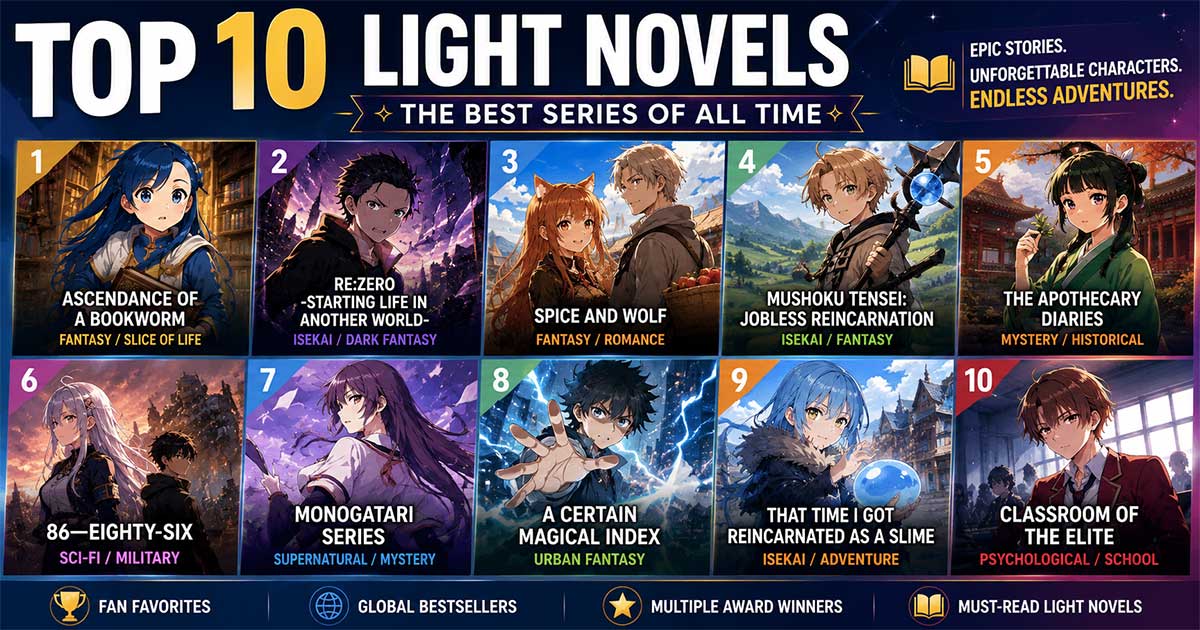
What Are the Top 10 Light Novels?
What Are the Top 10 Light Novels? The Best Series to Read Choosing the top 10 Light Novels is more complicated than simply finding the ten bestselling series. Sales measure commercial reach, while reader rankings measure enthusiasm, awards reflect critical or industry recognition, and long-running…
Continue reading...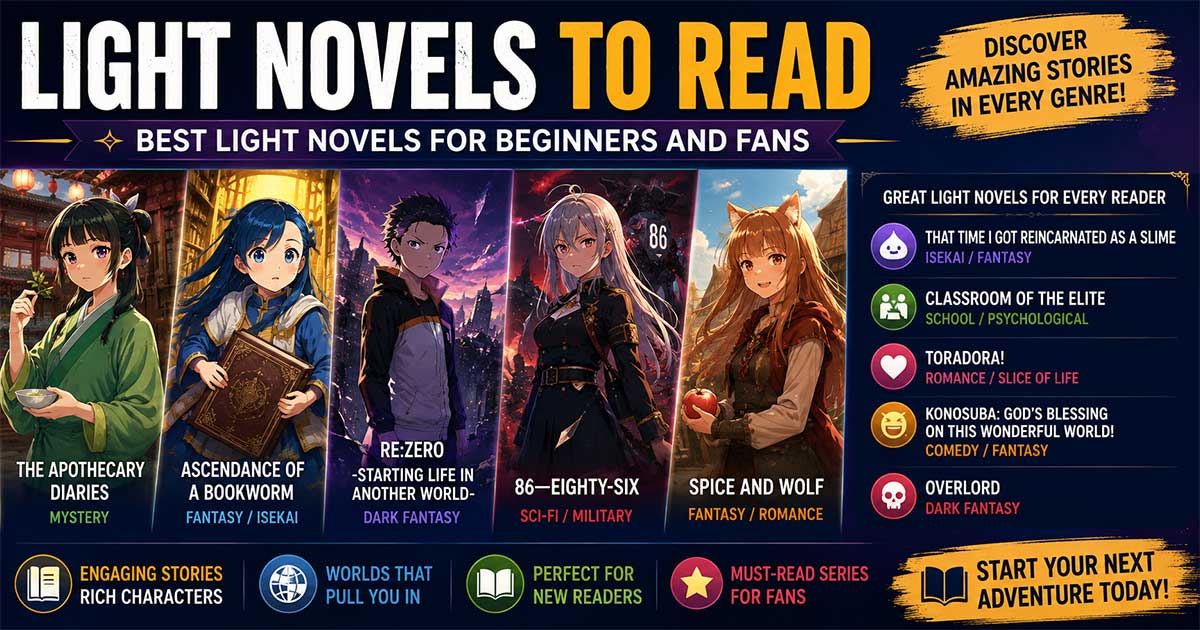
Light Novels to Read
Light Novels to Read: Best Light Novels for Beginners and Fans Finding the best Light Novels to read can be surprisingly difficult. The English-language market now includes everything from enormous isekai adventures and psychological thrillers to historical mysteries, romantic dramas, science fiction, and comedy. For…
Continue reading...