
What Exactly Is a Light Novel?

What Exactly Is a Light Novel? A Complete Guide to the Japanese Publishing Format
If you watch anime, read manga, or explore Japanese popular fiction, you have probably encountered the term Light Novel. Many successful anime franchises are based on Light Novels, and the format has become increasingly accessible to English-speaking readers through translations and international publishing.
But what exactly is a Light Novel?
The simple answer is that a Light Novel is a Japanese publishing category centered on prose fiction, commonly aimed at teenage and young adult audiences and often featuring manga- or anime-style illustrations. However, that definition only tells part of the story.
A Light Novel is not simply a short novel with pictures. It is part of a distinctive Japanese publishing culture with its own labels, imprints, readership, storytelling conventions, and relationship with manga, anime, and web fiction.
Understanding what makes a Light Novel requires looking at its origins, format, length, writing style, illustrations, and—most importantly—the way the term is actually used by the Japanese publishing industry.
What Is a Light Novel?
A Light Novel, known in Japanese as raito noberu (ライトノベル) and sometimes shortened to ranobe (ラノベ), is a category of Japanese popular fiction.
Unlike manga, the primary storytelling medium is written prose. Readers experience the story through narration, dialogue, description, and internal thoughts rather than through sequential comic panels.
Many Light Novels contain illustrations, particularly character artwork and important scenes, but those images support the prose rather than replace it.
Light Novels are commonly associated with younger audiences, particularly teenagers and young adults, although their actual readership can extend well beyond those age groups.
They also cover a surprisingly broad range of genres, including:
Fantasy
Isekai
Romance
Romantic comedy
Science fiction
Mystery
School life
Supernatural fiction
Adventure
Action
Horror
There is therefore no single type of Light Novel story. The term describes a publishing tradition and market category much more than a specific genre.
Why Are They Called “Light Novels”?
The word Light Novel can be misleading to English-speaking readers.
“Light” does not necessarily mean that the story is cheerful, simplistic, or lacking serious themes. Light Novels can deal with war, death, politics, trauma, social conflict, or complex fantasy worlds.
Nor does “light” impose a strict maximum length.
The expression comes from the Japanese term ライトノベル (raito noberu), constructed from English-derived words but used as a distinctly Japanese publishing expression.
The “light” aspect is better understood in relation to accessibility and reading experience. Many Light Novels emphasize readable prose, dialogue, character interaction, relatively compact volumes, and an approachable presentation.
That makes the category particularly suited to readers who want novel-length storytelling while remaining close to the visual and narrative culture surrounding manga and anime.
What Makes a Book a Light Novel?
This is where the definition becomes more complicated.
There is no universal technical checklist stating that a book becomes a Light Novel when it reaches a particular word count, contains a certain number of illustrations, or uses a specific writing style.
Instead, several characteristics commonly appear together.
It Is Primarily Prose Fiction
The most fundamental characteristic is simple: a Light Novel is still a novel.
Its story is primarily communicated through words.
A volume may include character illustrations, maps, decorative pages, or full-page scenes, but a reader should not confuse those elements with manga storytelling.
This distinction matters because manga and Light Novels can tell exactly the same story while providing very different reading experiences.
It Is Connected to Japanese Publishing Culture
Calling any short illustrated novel a Light Novel would be too broad.
The term developed within Japan and is strongly associated with Japanese publishers, dedicated Light Novel imprints, awards, marketing categories, and media franchises.
Publishers such as Kadokawa have played an important role in the development and expansion of Light Novel publishing.
This industry context is one reason the definition can become controversial outside Japan. English-language writers may intentionally adopt Light Novel conventions, but whether an original English work should technically be classified as a Light Novel depends on how broadly the term is being used.
In everyday international usage, the definition is becoming increasingly flexible.
Illustrations Are Common, but They Are Not the Story
One of the most recognizable features of a Light Novel is its artwork.
Covers frequently use anime- or manga-inspired character designs. Interior volumes may contain several illustrations depicting major characters, dramatic scenes, emotional moments, or important locations.
Some editions also include color artwork near the beginning of the book.
However, a common misconception is that Light Novels are essentially heavily illustrated books.
They are not.
Readers may go through many pages of uninterrupted prose before encountering another illustration. The artwork contributes to characterization and visual identity, but the author still carries the narrative through text.
How Long Is a Light Novel?
There is no mandatory Light Novel word count.
A commonly cited range is approximately 40,000 to 50,000 words for an individual volume, although actual books can be shorter or considerably longer.
Page counts are equally variable because Japanese and English editions differ in dimensions, typography, translation, formatting, and illustration placement.
Many volumes fall somewhere around 200 to 300 pages, but this should be treated as a useful reference point rather than a definition.
A 350-page book does not suddenly stop being a Light Novel.
Likewise, a 150-page book is not automatically one.
Publishing identity matters more than reaching an exact number of pages.
How Is a Light Novel Different From a Traditional Novel?
The difference between a Light Novel and a novel is not absolute because a Light Novel is a novel.
The distinction is primarily about publishing culture, audience, presentation, and common stylistic tendencies.
Traditional novels can range from literary fiction to enormous fantasy epics and may target virtually any readership. Light Novels are more strongly associated with accessible serialized entertainment, younger demographics, illustrated character designs, and close relationships with manga and anime culture.
Their prose often emphasizes dialogue and immediate character interaction. Chapters and scenes may move quickly, particularly in action, comedy, romance, and adventure series.
However, these are tendencies rather than rules.
Some Light Novels contain extensive worldbuilding, complicated political systems, long internal monologues, or sophisticated narrative structures.
The category is far more diverse than the word “light” might suggest.
Light Novel vs Manga: What Is the Difference?
The clearest difference between a Light Novel and manga is the medium used to tell the story.
Manga relies primarily on sequential artwork, speech balloons, visual composition, and panels.
A Light Novel relies primarily on prose.
Imagine a battle between two characters.
In manga, the artist can communicate speed, movement, expressions, destruction, and positioning directly through drawings.
In a Light Novel, the author must communicate those same elements through language, allowing the reader to construct the action mentally. An illustration might show one crucial instant from the battle, but it does not replace the written sequence.
This distinction also explains why adaptations can differ significantly from their source material. A manga or anime adaptation must transform written narration and internal thoughts into visual storytelling.
Light Novel vs Web Novel
The distinction between a Light Novel and a web novel is especially important because many modern Light Novel series begin online.
A web novel is primarily defined by how and where it is published. Authors may release chapters on online fiction platforms, sometimes over months or years.
When a publisher acquires a successful web novel, the work may undergo substantial editing before becoming a commercially published Light Novel.
That process can involve:
Rewriting scenes
Changing the pacing
Correcting continuity problems
Adding or removing chapters
Revising characters
Commissioning professional illustrations
Dividing the story into commercial volumes
Consequently, the Light Novel edition and original web novel of the same series are not necessarily identical.
The web novel may be the prototype; the published Light Novel becomes the professionally edited commercial edition.
Why Do So Many Light Novels Become Anime?
Light Novels exist within a much larger Japanese entertainment ecosystem.
A successful story can move between several formats:
Web Novel → Light Novel → Manga → Anime
This is not a mandatory progression, and adaptations can occur in different orders, but the pattern has become familiar.
A prose series already provides characters, worldbuilding, plot arcs, and an existing audience. Manga adaptations can introduce the property to visually oriented readers, while anime can dramatically increase its international visibility.
This relationship is particularly noticeable in fantasy and isekai Light Novels.
Well-known franchises such as Sword Art Online, Re:Zero − Starting Life in Another World, That Time I Got Reincarnated as a Slime, and The Rising of the Shield Hero demonstrate how stories associated with Light Novel publishing can expand into manga, anime, games, merchandise, and other media.
For many international viewers, the anime adaptation is actually their first encounter with a story that originated as prose fiction.
Are All Light Novels Japanese?
Traditionally, Light Novel refers to a Japanese publishing category.
International publishing has made the terminology more complicated.
English translations of Japanese Light Novels are obviously still called Light Novels. But authors outside Japan increasingly write original fiction inspired by the same traditions: anime-influenced illustrations, serialized volumes, fantasy or isekai settings, dialogue-focused storytelling, and similar presentation.
These works are sometimes described as Original English Light Novels (OELNs) or simply English Light Novels.
Whether the term should apply exclusively to Japanese works remains debated among readers. From a historical and industry perspective, its Japanese origin is essential. From a modern descriptive perspective, however, “Light Novel” is increasingly used internationally to identify a recognizable style and publishing format.
The distinction is therefore best stated clearly rather than treated as an absolute rule.
What Does a Light Novel Look Like?
A typical Light Novel volume often combines several recognizable elements:
A colorful illustrated cover
A relatively compact physical format
Primarily prose-based storytelling
Anime- or manga-influenced character artwork
Occasional interior illustrations
Strong emphasis on characters and dialogue
A story divided across multiple volumes
Series structure is particularly important.
Rather than telling an enormous story inside one massive book, many Light Novel series divide their narratives into manageable volumes. Individual books can resolve an immediate conflict while continuing a larger character or story arc.
This structure makes the format particularly effective for fantasy, romance, adventure, school stories, and long-running isekai narratives.
Why Have Light Novels Become Popular Internationally?
Anime and manga created a natural international audience for Light Novels.
As viewers discovered that some of their favorite anime were adaptations, many began searching for the original books—especially when an anime ended before completing the story.
English-language publishers and digital distribution then made translated volumes considerably easier to obtain.
Today, readers can discover translated and original series through a growing number of English Light Novel websites and digital publishing platforms.
Light Novels also occupy an attractive position between different forms of entertainment. They offer considerably more textual detail than anime or manga while retaining many of the characters, genres, visual aesthetics, and storytelling conventions familiar to those audiences.
For an anime fan interested in reading more prose fiction, a Light Novel can therefore feel like a natural bridge.
Frequently Asked Questions About Light Novels
What qualifies as a Light Novel?
There is no universal technical definition. The term traditionally refers to Japanese popular novels published and marketed within the Light Novel category, commonly targeting younger readers and often featuring anime- or manga-style illustrations.
Do Light Novels have pictures?
Usually, yes, but illustrations are supplementary. A Light Novel remains primarily prose fiction and may contain long sections without artwork.
How many pages does a Light Novel have?
Many volumes contain roughly 200 to 300 pages, but there is no mandatory page count. Format, publisher, language, and edition can substantially affect the number of pages.
Is a Light Novel the same as manga?
No. A Light Novel tells its story primarily through written prose, while manga tells its story primarily through sequential artwork and panels.
Why is it called a Light Novel?
The term comes from the Japanese raito noberu. “Light” generally reflects the category's accessible presentation and reading style rather than a requirement that the story be short, simple, or lighthearted.
Can a Light Novel become an anime?
Yes. Many anime series are adaptations of successful Light Novels. Some properties also receive manga adaptations, games, films, and other media.
Conclusion
So, what exactly is a Light Novel?
At its core, a Light Novel is a form of prose fiction rooted in the Japanese publishing industry, commonly associated with accessible storytelling, younger audiences, illustrated characters, serialized volumes, and strong connections to manga and anime culture.
But reducing the definition to “a short Japanese book with manga pictures” misses what makes the format distinctive.
There is no magical page count, required number of illustrations, or single writing formula that turns a novel into a Light Novel. Its identity comes from a combination of publishing history, market positioning, presentation, audience, and storytelling traditions.
That flexibility is also one of the reasons the format has expanded so successfully beyond Japan.
Today, the Light Novel stands at the intersection of literature and modern Japanese popular culture: prose stories capable of developing into manga, anime, games, and international franchises while still offering something those visual formats cannot fully reproduce—the depth, imagination, and freedom of a novel.
You should also read:
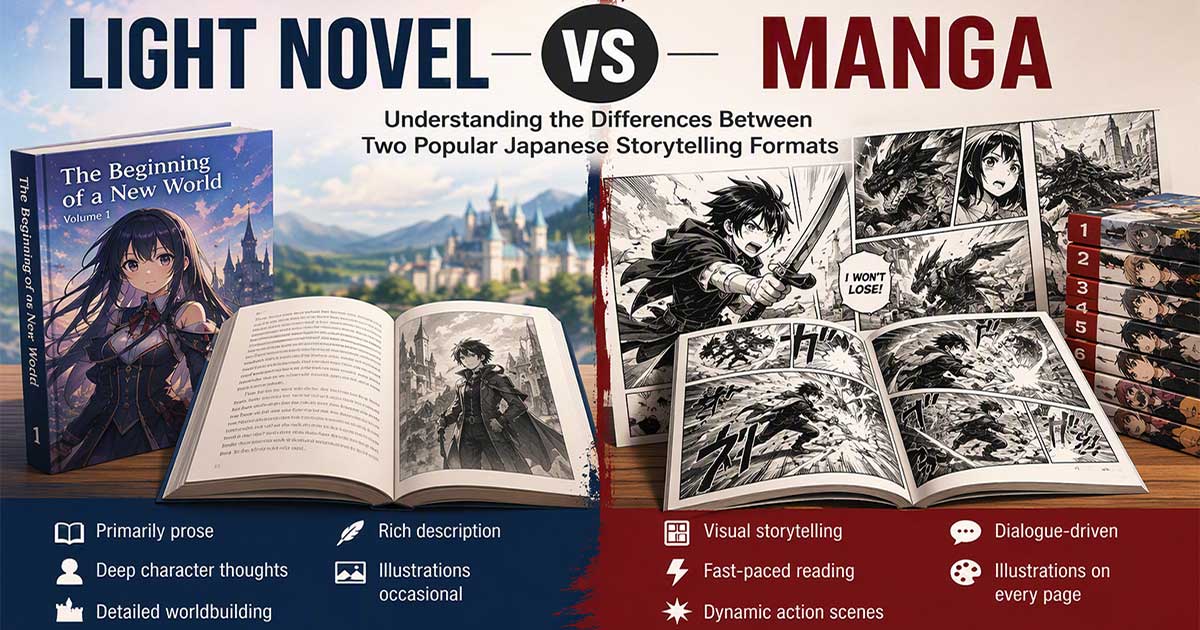
Light Novel vs Manga
Light Novel vs Manga: Understanding the Differences Between Two Popular Japanese Storytelling Formats Japanese storytelling has become a global phenomenon. From bestselling manga to blockbuster anime adaptations, millions of readers discover new stories every year. Yet one format often remains misunderstood outside Japan: the Light…
Continue reading...
Light Novel Websites
Light Novel Websites: Where to Read, Learn, and Explore the World of Light Novels The popularity of the light novel has expanded far beyond Japan. As more readers discover this unique style of storytelling, the number of light novel websites has grown significantly. Today, some…
Continue reading...
Light Novels to Read
Light Novels to Read: Best Light Novels for Beginners and Fans Finding the best Light Novels to read can be surprisingly difficult. The English-language market now includes everything from enormous isekai adventures and psychological thrillers to historical mysteries, romantic dramas, science fiction, and comedy. For…
Continue reading...