
What Are the Top 10 Light Novels?
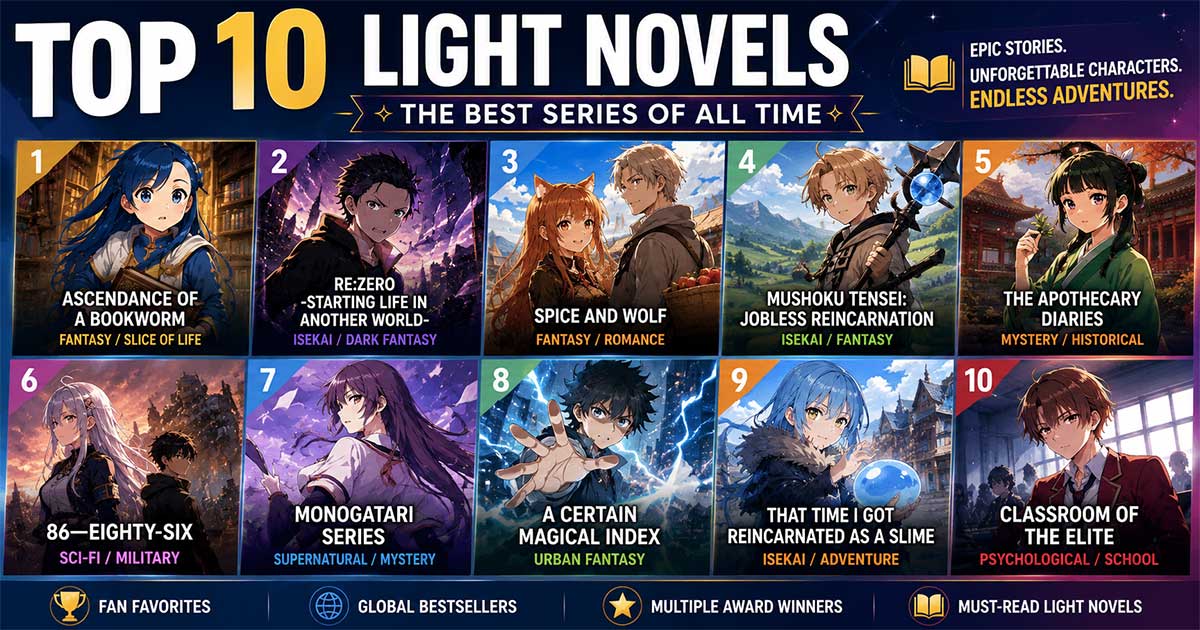
What Are the Top 10 Light Novels? The Best Series to Read
Choosing the top 10 Light Novels is more complicated than simply finding the ten bestselling series. Sales measure commercial reach, while reader rankings measure enthusiasm, awards reflect critical or industry recognition, and long-running franchises benefit from having had more time to build an audience.
A useful list therefore needs broader criteria.
The ten Light Novel series below were selected for a combination of literary reputation, reader recognition, influence on the medium, longevity, international visibility, distinctive storytelling, and importance within their respective genres. The result includes major isekai works, science fiction, romance, supernatural fiction, historical mystery, and urban fantasy.
It is not intended to claim that personal taste can be reduced to an objective score. Instead, these are ten series that provide an excellent picture of what the Light Novel medium can achieve.
Top 10 Light Novels at a Glance
| Rank | Light Novel | Author | Best Known For |
|---|---|---|---|
| 1 | Ascendance of a Bookworm | Miya Kazuki | Worldbuilding and social development |
| 2 | Re:ZERO −Starting Life in Another World− | Tappei Nagatsuki | Psychological isekai |
| 3 | Spice and Wolf | Isuna Hasekura | Romance and economics |
| 4 | Mushoku Tensei: Jobless Reincarnation | Rifujin na Magonote | Character-driven isekai |
| 5 | The Apothecary Diaries | Natsu Hyūga | Mystery and court intrigue |
| 6 | 86—Eighty-Six | Asato Asato | Military science fiction |
| 7 | Monogatari | Nisio Isin | Dialogue and experimental storytelling |
| 8 | A Certain Magical Index | Kazuma Kamachi | Expansive science-and-magic universe |
| 9 | That Time I Got Reincarnated as a Slime | Fuse | Nation-building fantasy |
| 10 | Classroom of the Elite | Shōgo Kinugasa | Psychological strategy |
1. Ascendance of a Bookworm
Best for worldbuilding
Ascendance of a Bookworm earns the top position because it demonstrates how ambitious a Light Novel can become without depending primarily on combat.
The story follows a book-loving woman reincarnated as Myne, a sickly young girl in a society where books are expensive luxuries. Her seemingly modest ambition—to have books again—gradually forces her to interact with craftspeople, merchants, religious institutions, nobles, and political structures.
Its worldbuilding is unusually consequential. Innovations do not exist in isolation. Manufacturing something new requires materials and labor. Commerce changes relationships. Social class limits opportunities. Technology can threaten established interests.
The series consequently develops from a personal story into a remarkably broad fantasy narrative.
Its completed main story also makes it attractive to readers who prefer a long series with a defined destination.
Why it stands out: exceptionally coherent worldbuilding, gradual social development, strong protagonist, and long-form storytelling.
2. Re:ZERO −Starting Life in Another World−
Best psychological isekai
Re:ZERO takes one of fantasy's most desirable abilities—returning from death—and explores why possessing it could be horrifying.
Subaru Natsuki arrives in another world without the effortless power fantasy he might have expected. Instead, death can return him to an earlier point, allowing him to try again while retaining the memories and psychological consequences of what happened.
This mechanism makes failure part of the narrative structure.
Subaru must discover what went wrong, understand other characters, change his behavior, and sometimes endure repeated catastrophes before finding a path forward.
The Light Novel format is especially effective for this kind of story because internal narration can reveal fear, self-deception, desperation, and gradual emotional change with a depth difficult to reproduce completely on screen.
Why it stands out: psychological intensity, intricate plotting, memorable characters, and creative use of time loops.
3. Spice and Wolf
Best fantasy romance
Spice and Wolf proves that fantasy does not need constant warfare to generate tension.
Traveling merchant Kraft Lawrence encounters Holo, a wolf deity who wishes to return north. Their journey becomes a combination of medieval-inspired commerce, economics, religion, negotiation, and romance.
A currency fluctuation or commercial agreement can become as consequential as a magical confrontation in another series.
But economics alone does not explain the story's enduring reputation.
Its greatest strength is the relationship between Lawrence and Holo. Their verbal sparring, intelligence, vulnerabilities, and slowly developing affection turn long conversations into some of the series' most important scenes.
Why it stands out: outstanding character chemistry, unusual economic plots, mature romance, and a distinctive fantasy setting.
4. Mushoku Tensei: Jobless Reincarnation
Best character-driven isekai
Mushoku Tensei has become one of the most recognizable titles associated with modern isekai.
Its protagonist dies after a deeply unsuccessful life and is reincarnated as Rudeus Greyrat in a fantasy world. Retaining memories of his previous existence gives him knowledge and perspective, but not an entirely new personality.
That distinction is central to the story.
Rudeus receives a second opportunity, yet personal growth remains difficult and uneven. The narrative follows him across years rather than treating reincarnation as an instant transformation into an ideal hero.
The series is also notable for its extensive fantasy world, travel, magic, relationships, family dynamics, and long-term consequences.
Some aspects of its protagonist and subject matter remain controversial among readers, and that controversy is worth acknowledging rather than ignoring. Nevertheless, its influence on contemporary isekai is substantial.
Why it stands out: long-term character development, influential isekai structure, expansive world, and strong sense of progression.
5. The Apothecary Diaries
Best historical mystery
The Apothecary Diaries offers something dramatically different from the stereotypical image of a Light Novel.
Maomao is a young apothecary whose knowledge of medicine, herbs, diseases, and poisons brings her into mysteries within an imperial court.
Rather than defeating enemies through supernatural strength, she succeeds through observation.
An unexplained illness, unusual behavior, a cosmetic product, food, medicine, or poison can provide the clue that reveals what is really happening.
The palace environment also creates a rich social structure involving servants, officials, consorts, political interests, and strict hierarchies.
The result combines episodic mysteries with larger character and political arcs.
Why it stands out: intelligent protagonist, medical mysteries, court intrigue, and a distinctive historical-inspired setting.
6. 86—Eighty-Six
Best military science-fiction Light Novel
86—Eighty-Six shows the medium's ability to handle serious science-fiction themes.
Its society publicly presents its war as being fought by autonomous machines. The truth is far darker: marginalized people known as the Eighty-Six are doing the actual fighting while much of society treats their deaths as irrelevant.
That premise allows the series to explore institutional discrimination, propaganda, war, trauma, responsibility, and the deliberate dehumanization of others.
Its military action is important, but the emotional relationship between those fighting and those observing the war from relative safety gives the story much of its power.
Why it stands out: mature themes, military tension, social commentary, and emotionally effective character relationships.
7. Monogatari Series
Best for distinctive prose and dialogue
Nisio Isin's Monogatari series is one of the more unusual entries on this list.
Supernatural phenomena provide its framework, but language is one of its real attractions.
Long conversations, wordplay, unreliable perspectives, character psychology, unusual narrative structures, and verbal confrontations make the reading experience fundamentally important.
That also makes Monogatari less universally accessible than some other recommendations.
Readers seeking straightforward action may find its dialogue-heavy approach demanding. Readers who enjoy unusual prose and characters communicating through layers of jokes, misdirection, emotion, and implication may discover exactly why the series has such a devoted following.
Why it stands out: unmistakable authorial voice, experimental narration, supernatural mysteries, and dialogue-centered storytelling.
8. A Certain Magical Index
Best expansive universe
A Certain Magical Index helped establish the scale a long-running Light Novel franchise could achieve.
Its setting brings two seemingly incompatible systems together: advanced science and supernatural magic.
Academy City represents the scientific side, with technologically developed environments and supernatural abilities studied through scientific institutions. Beyond that exists an enormous world of magical traditions, religious organizations, competing factions, and hidden conflicts.
The attraction lies increasingly in the interaction between these systems.
Characters and organizations that initially seem separate gradually become parts of a much larger network of conflicts.
Why it stands out: enormous lore, science-versus-magic premise, extensive cast, and long-term franchise influence.
9. That Time I Got Reincarnated as a Slime
Best nation-building isekai
The protagonist of That Time I Got Reincarnated as a Slime begins his new life as one of fantasy gaming's least intimidating creatures.
That situation does not last.
After becoming Rimuru Tempest, he acquires abilities, allies, and influence. What begins as an unconventional reincarnation story grows into something much larger: the construction of a society.
Different species must coexist. Alliances have to be negotiated. Resources matter. Other nations respond to Rimuru's growing power. Diplomacy and economics gradually become important alongside combat.
This expansion from individual progression to nation-building distinguishes the series from many simpler power fantasies.
Why it stands out: accessible adventure, progression, diplomacy, worldbuilding, and large-scale nation development.
10. Classroom of the Elite
Best psychological strategy series
Classroom of the Elite demonstrates that an acclaimed Light Novel does not need fantasy, reincarnation, or magic.
Its prestigious school operates through an elaborate competitive system in which students and classes must fight for status and advantages.
The weapons are often information, manipulation, alliances, deception, and psychology.
Kiyotaka Ayanokōji initially appears deliberately unremarkable, but the gradual revelation of his abilities and background becomes a central element of the series.
The school itself functions almost like a controlled social experiment, repeatedly forcing students to decide whom they trust and how far they will go to succeed.
Why it stands out: strategic conflicts, psychological manipulation, social competition, and an enigmatic protagonist.
What Makes a Light Novel One of the Best?
No authoritative organization can objectively declare the ten greatest Light Novels.
Different measurements produce different lists.
Sales favor commercially successful and long-running franchises. Reader ratings can elevate smaller series with passionate audiences. Annual rankings capture a particular moment in the market. Anime adaptations dramatically increase international awareness, while older influential series may be less visible to newer readers.
A stronger evaluation considers several factors together:
Quality and consistency of storytelling
Character development
Worldbuilding
Influence on later works
Reader reception
Longevity
Originality
International impact
Strength within its genre
This is also why the best-selling Light Novel and the best Light Novel are not automatically the same thing.
Popularity is evidence of impact, not a mathematical measurement of quality.
Which Top Light Novel Should You Read First?
For a newcomer, The Apothecary Diaries is particularly accessible if mystery appeals to you, while That Time I Got Reincarnated as a Slime provides an approachable introduction to isekai.
Readers wanting deep fantasy worldbuilding should consider Ascendance of a Bookworm. Those seeking darker psychological material can begin with Re:ZERO. Spice and Wolf is an excellent choice for romance and dialogue, while 86—Eighty-Six works especially well for science-fiction readers.
The best entry point is ultimately the title closest to genres you already enjoy.
For a broader selection, our guide to Light Novels to read offers recommendations for both beginners and experienced fans.
Frequently Asked Questions
What is the number one Light Novel?
There is no universally recognized number-one Light Novel. Rankings vary according to sales, reader votes, critical reputation, genre, and personal preference. In this guide, Ascendance of a Bookworm takes first place for its exceptional long-form worldbuilding and narrative development.
What are the most popular Light Novels?
Internationally recognizable series include Re:ZERO, Mushoku Tensei, That Time I Got Reincarnated as a Slime, A Certain Magical Index, Classroom of the Elite, and The Apothecary Diaries, among many others.
What is the best Light Novel for beginners?
The Apothecary Diaries and That Time I Got Reincarnated as a Slime are approachable starting points. Readers can also begin with the original Light Novel behind an anime series they already enjoy.
Readers looking for these series online can also explore where to find Light Novels through established websites and publishers.
Are the best-selling Light Novels also the best?
Not necessarily. Sales demonstrate commercial popularity but cannot measure prose quality, originality, characterization, or individual reader preference.
Are all top Light Novels isekai?
No. This list includes historical mystery, romance, military science fiction, supernatural fiction, school drama, and urban fantasy alongside isekai.
Conclusion
The question “What are the top 10 Light Novels?” has no permanently objective answer, but certain series repeatedly distinguish themselves through influence, readership, storytelling, worldbuilding, or innovation.
Ascendance of a Bookworm, Re:ZERO, Spice and Wolf, Mushoku Tensei, The Apothecary Diaries, 86—Eighty-Six, Monogatari, A Certain Magical Index, That Time I Got Reincarnated as a Slime, and Classroom of the Elite collectively demonstrate how diverse the medium has become.
More importantly, they challenge the idea that a Light Novel represents one specific kind of story.
From medieval economics and imperial-court mysteries to time loops, warfare, school competition, supernatural phenomena, and entire fantasy civilizations, the best Light Novels show that the format is not defined by one genre.
It is a remarkably flexible form of prose storytelling—and these ten series provide ten very different reasons to explore it.
You should also read:

What Exactly Is a Light Novel?
What Exactly Is a Light Novel? A Complete Guide to the Japanese Publishing Format If you watch anime, read manga, or explore Japanese popular fiction, you have probably encountered the term Light Novel. Many successful anime franchises are based on Light Novels, and the format…
Continue reading...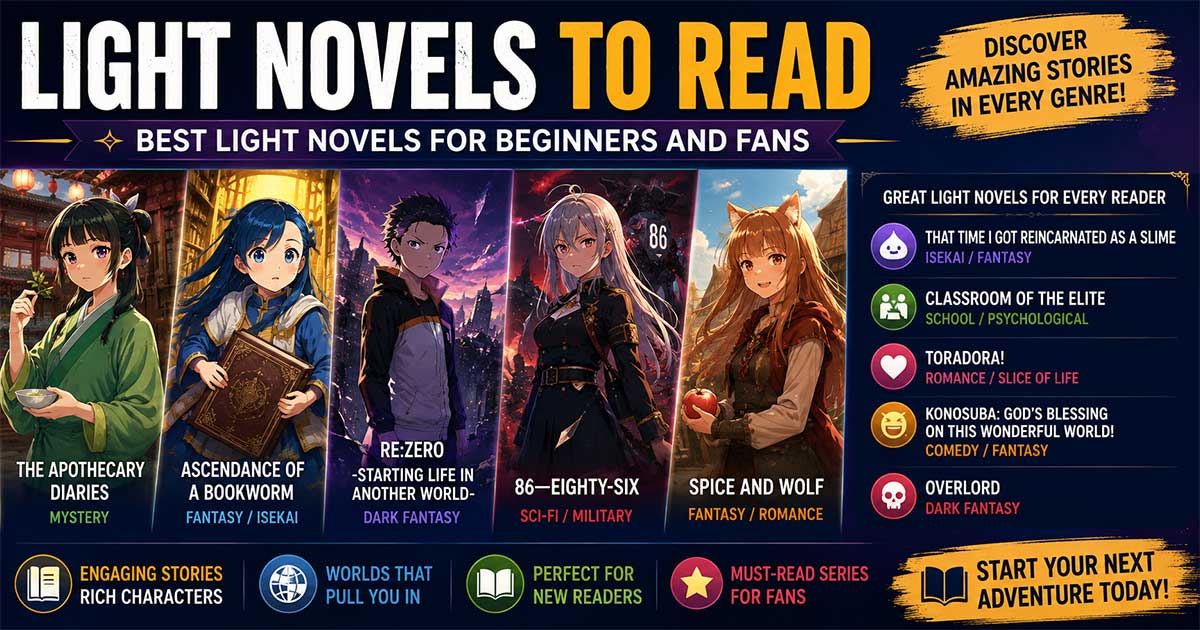
Light Novels to Read
Light Novels to Read: Best Light Novels for Beginners and Fans Finding the best Light Novels to read can be surprisingly difficult. The English-language market now includes everything from enormous isekai adventures and psychological thrillers to historical mysteries, romantic dramas, science fiction, and comedy. For…
Continue reading...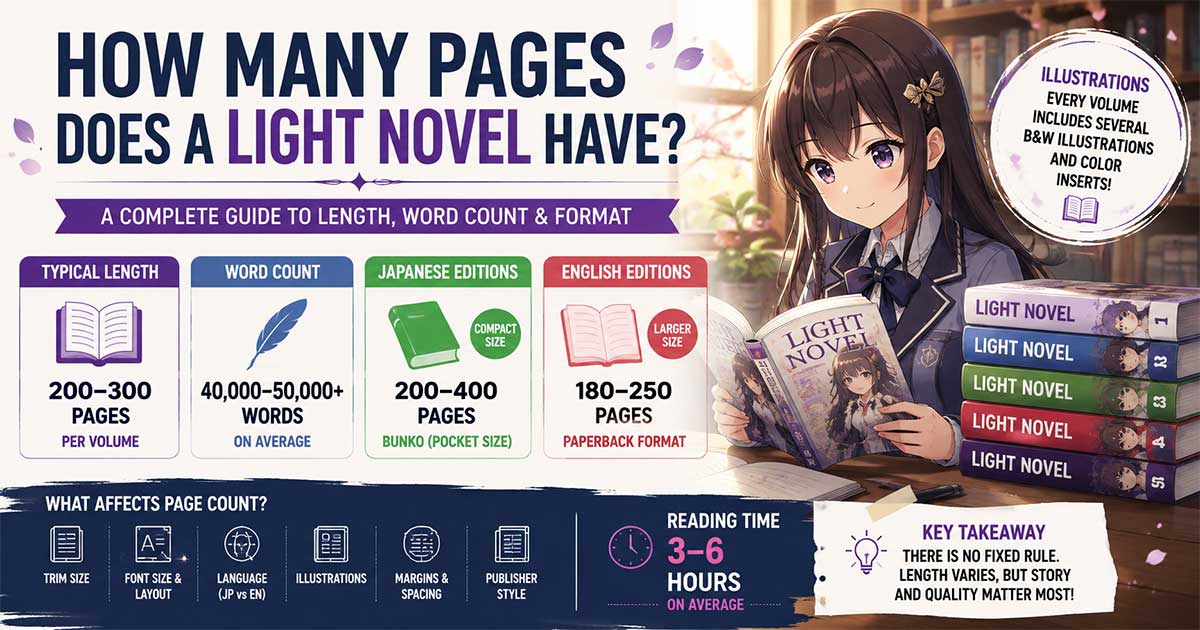
How Many Pages Does a Light Novel Have?
How Many Pages Does a Light Novel Have? Length, Word Count and Format Explained A typical Light Novel contains roughly 200 to 300 pages per volume, but that number is only a useful reference point—not a publishing rule. Some volumes are considerably shorter, while others…
Continue reading...